Lockheart Paul - Measurement (Review)
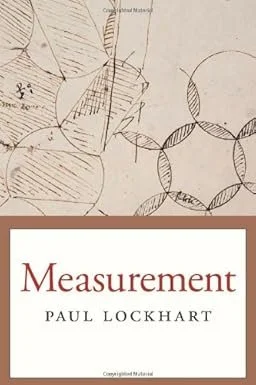
A foray into a perfect world
For a while now, I have been reading on the topic of pedagogy and the question of how we teach and how we learn. During this reading, by coincidence, I came across Lockhart's first book, "A Mathematician's Lament".
When I went to buy it, unfortunately, it was unavailable, but Measurement was available. That is how I got the situation that I read the second book before the first. And from that experience, I can wholeheartedly say that you do not need to read the first one first, either.
In Measurement, Lockheart aims to introduce the reader to the "beautiful" and "perfect" world of mathematics. And the way he does that is ingenious. By starting with a simple question:
While playing with triangles in your mind's eye. When connecting the corners of the triangle with the opposing midpoint, the lines all intersect in the same point. Why?
In developing the mental tools to answer the question, we explore the world of shapes and sizes. We get an intuitive, step-by-step introduction to mathematical concepts, starting with geometry and trigonometry, then moving on to motion and time, leading into vectors, differentials, and logarithms.
One of Lockheart's prime arguments is that maths is the exploration of a beautiful, perfect imaginary world within each of us. And that the exercise of mathematical thinking is less about getting the "correct" answer. Rather, it is about exploring why and how these shapes and numbers behave the way they do. He describes mathematics in the parlance of philosophy. An exercise in logical thinking itself. The construction of an answer is training for the formation of an argument. And like an argument, the "answer" can constantly be improved. It is a lighthearted approach and openness to exploration and creativity in play that make his approach so refreshing and enticing.
The Explanation flows naturally, and at no point did I feel that the explanation glossed over details or introduced concepts beyond the capabilities of the reader. I will admit that I am not the intended audience for this book. I already possess a background in mathematics and have a deep love for numbers and the beauty of the mathematical world. I would, however, stand by my statement, taking the presumption that one came to this book naive of mathematics. Such as the staunch Humanist, or reluctant high school mathstrugler
One of my favourite feature of this book are the questions sprinkled throughout. Just as he finishes explaining a concept, he will pose a question. One that is within the grasp of the tools you now possess. However, it stretches your mind to use these tools in ways you haven't before. Thus, reinforcing the knowledge you already have.
These well-timed teasers keep your mind engaged. Although they also increase the book's reading time considerably. If you wait to progress until you have finished solving the question posed. And I highly recommend you do. Measurement is not a book to rush through on the sprint to the next title. It is very much a book you spend some time with. In keeping with Lockheart’s intention, the book was meant as an introduction to mathematics. To spend 6 months or more is not a shame. And even re-reading it occasionally would not go amiss.
I mentioned that I am not the intended target audience for the book on the grounds of my preexisting interest in mathematics. Nevertheless, this book proved eye-opening for me. I was never a friend to the world of trigonometry, always preferring the dynamic world of vectors and differentials. But while working through one of the trigonometry questions, the scales on a relationship that had eluded me since my early school days now became clear. Moving a task that was condemned to route memorisation into one of understanding and internalisation.
I wish and hope that mathematical teachers read this book. And while I labour under no illusion that this book ever could become part of the mathematical syllabus here in Norway. I, for one, will aim to use this book to help anyone I come across who has lost sight of the beautiful, perfect world that lies inside all of us.
Bibliography
Lockheart Paul (2012) Measurement. First Harvard University Press. USA. ISBN:978-0-674-05755-5 Dewey: 516