Steven Strogatz - Infinite Powers The history of calculus (Review)
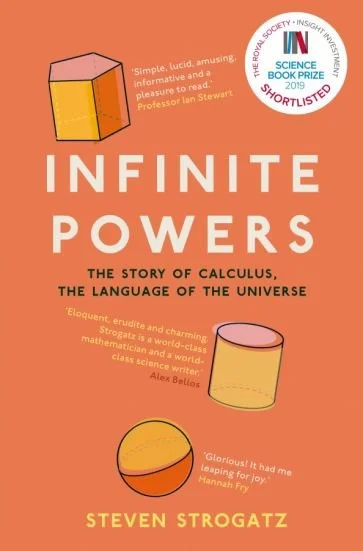
Infinite Powers joins the ranks of books that aim to demystify the field of mathematics. Mathematics, as a subject, is seen in today's world as a "hard" subject. And one that one in common parlance needs "the head for". For that reason, many people who struggle with mathematics in high school or even earlier abandon the field with a shrug of "I don't have the head for this".Never to bother with it again.
Authors like Strogatz would like to change this perception of mathematics. It is undeniable that, amongst people who "get maths", the subject of mathematics is likely to elicit joyous exclamations. To the frustrations of our non-mathematical acquaintances, the right (or maybe the wrong) question can bring forth an endless stream of erudition on why mathematics is great.
In the opening chapter of the book, Strogatz quotes the famous saying by Feynman that Calculus "is the language God talks". And I join him in his explanation, Calculus is the logical framework that allows us to understand nature around us at a level far beyond our everyday senses. It allows us to ask nature why? Why are things the way they are? What are the consequences of nature being the way it is?
While calculus is the language of nature, we needed to develop the ability to understand and speak this language ourselves. The book takes the reader along on a journey through time, tracing the path we took to discover or invent Calculus. The textbook answer is that Newton and Leibniz invented Calculus at the end of the seventeenth century. But Strogatz shows that all of mathematics is a history of standing on the shoulders of giants, by starting the history all the way back in antiquity. Introducing us to the concepts of infinity and limit in the form of Zeno's Paradoxes and the challenges geometers encounter in working with curved shapes. We get to read how Calculus was nearly discovered almost 2000 years before Newton's time by Archimedes of "Eureka!" fame. He explained his method of reasoning in the hopes that it would aid future mathematicians, only for it to be lost almost forever. His method was rediscovered only in the modern day. Proving to us how close Archimedes was to understanding the language of nature.
Strogatz tells us the story of how we kept finding glimpses of calculus again and again. But for unknown reasons, the knowledge of how to break a problem into infinitesimally small parts and put them back together again was lost until we needed it again.
Along the journey to see how Calculus blossomed into becoming the multitool in the mathematician's tool chest. We encounter the stories of everyday objects and events that we often take for granted. That would not have been possible without the help of calculus. Breakthroughs from the mundane to the fantastic. All rely on the same fundamental idea, and the result of piecing together what we now call Calculus.
Strogatz does a fantastic job tying the various steps leading to our ability to understand calculus to concepts that are familiar to any non-mathematician. The language and style are easy to follow, making for comfortable, fast reading. It was easy to find oneself flying through the pages, forgetting how time passes.
His judicious use of formulas and mathematical notation should help avoid the terror of math classes past. While in the cases where he resorts to them, he takes ample time to explain and walk the reader through them. Unmasking the fact that Mathematical notation has less to do with numbers, but much more with logical argumentation.
This book has an audience. It is an introductory text. Aimed at those without knowledge of maths and its history. For that reason, any person already familiar with the history of mathematics in general will find limited new understanding. The same goes for anyone already working with Calculus; this book is not for you. It is still a good read, but do not expect to come away with new secrets of calculus.
That said. In the final two chapters, Strogatz allows himself a little bit of a peek into the crystal ball. These forward-looking chapters were exciting and invigorating. On the off chance that He ever reads this, I do agree with you, so now we are a minority of two.
Calculus, as a field, holds the potential to move the needle in the development of mathematics. Infinite Powers does a fantastic job in bringing this powerful concept to the attention and understanding of the non-mathematician.
Bibliographic Information
Strogatz Steven (2019) Infinite Powers - The story of calculus, the language of the universe. Atlantic Books. London. Great Britain. ISBN: 978 1 78649 297 5 Dewey: 515.09