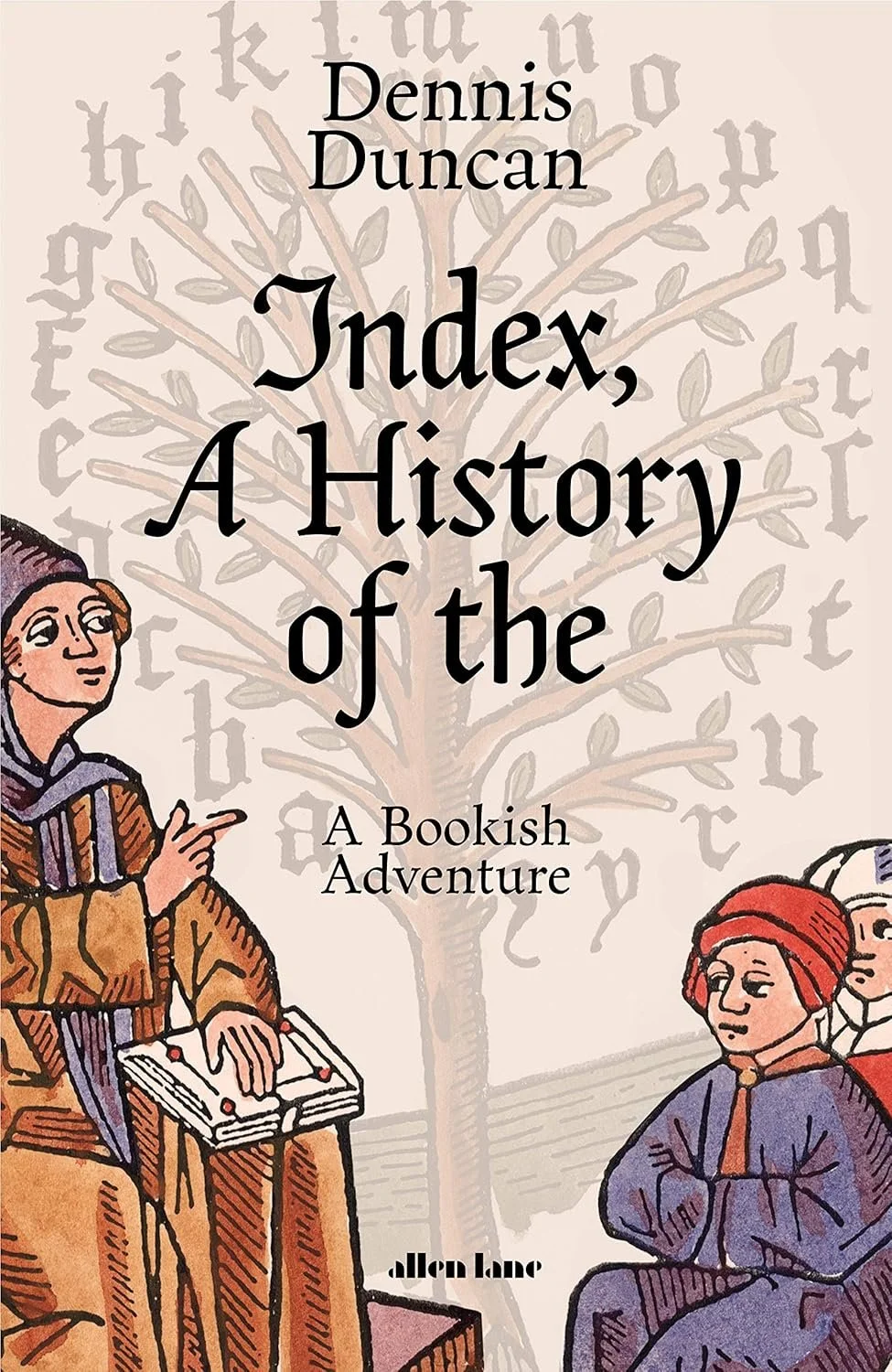
Dennis Duncan - Index, A History of the (Reiview)
I came across the history of the index via a good friend, who had learned that he was due to receive it for Christmas. In general, the books that this friend mentions are well worth reading. No sooner had he mentioned it than I had already bought it. My intention with the book was to read it purely for pleasure.
Without putting the cart before the horse. The book provided much more than simple pleasure; it made me reconsider the significance and overlooked value of indexes.
The history of the index naturally covers the history of the index. This humble little list is at the back of any self-respecting non-fiction book. A list that I will roughly admit often slips my attention when I first pick up a book to read for the first time, or any time that I sit down to read from cover to cover.
It now strikes me as baffling how oblivious I have been. How neglectful I have been in treating it over the years. For myself, I compile an index while reading. It is my habit to always have a pen at hand when reading. My bookmark is one of my index cards carrying the bibliographical information on the book, which marks the page. On the back, in minuscule script, so as not to waste space, a list of page numbers, along with notes and comments on the topics and passages that strike me as of value.
What else, if not an index, is this? The purpose of which is to find my way in the book to the nuggets of wisdom I want to come back to.
For that is the one use of the index I am familiar with. Tomes that hold that knowledge I know exist between their covers. But do not know where to find, and do not have the time or the gall to go looking for it by hand. In these times, from a brief acquaintance to my closest friends, the index grows. And many hours of searching for that one nugget were saved.
As such, I feel I owe it to the index to bring its history to the attention of a wider audience.
It is with the index as with so many things we take for granted. It is strange to think of a time when it did not exist. It took a human mind to come up with a list of terms that appear in a text. But it is with the index as with so many other obvious ideas that they never spring fully formed from the lexical ether. But it is a gradual process with several prerequisites and intermediate steps. Duncan performs admirably in setting up the story. Starting with what it takes to be an index. Where does it come from? How we moved both through time and through intellectual usage to make the index make sense.
That its history is an old one was new to me, but having read it, I now understand how it could not be. As intertwined as it is with the act of reading itself… But it could not always exist, and we unfurl the reasons why the index could not be an invention before its time. We learn of those who would rather see it dead. For the index, a tool to find information was feared for just this ability to bring the reader knowledge at a fraction of the effort required for scholarly reading.
But not all indices survived, and we learn of the indices that could have been.
While interesting, I find my own enthusiasm slightly less ardent than Duncan’s and wished that particular chapter to end a few pages earlier. While we engaged in observing the futile indexes. I find that an opportunity was missed. Duncan touches on the index's fate in the digital age. But this foray was tantalisingly short, leaving me with unanswered questions. How do we move the index with the times?
More importantly, why do we know so little about the profession and the people who create our indexes? For that was my greatest blind spot laid bare. Nearly a thought had I spent thinking about the person sitting and painstakingly working their way through the text to complete the signposts of knowledge. For the day, one might happen to need it. From the day I read about these unsung heroes, I will no longer think of the index the same way. I will always make a note to check the index and give its compiler the same thanks as the author of the main text. Both have contributed to making the knowledge available. And both are among the long traditions of highly dedicated writers.
And with that, my own little index finds its way into the drawer alongside the other scribbled personal index. All neatly arranged in alphabetical order. Ready for when a morsel of knowledge is needed, and I don't have the time or gall to go looking for it by hand.
Bibliography
Duncan Dennis (2022) Index, A history of the, Penguin Random House, Dublin, ISBN: 978-0-141-98966-2